
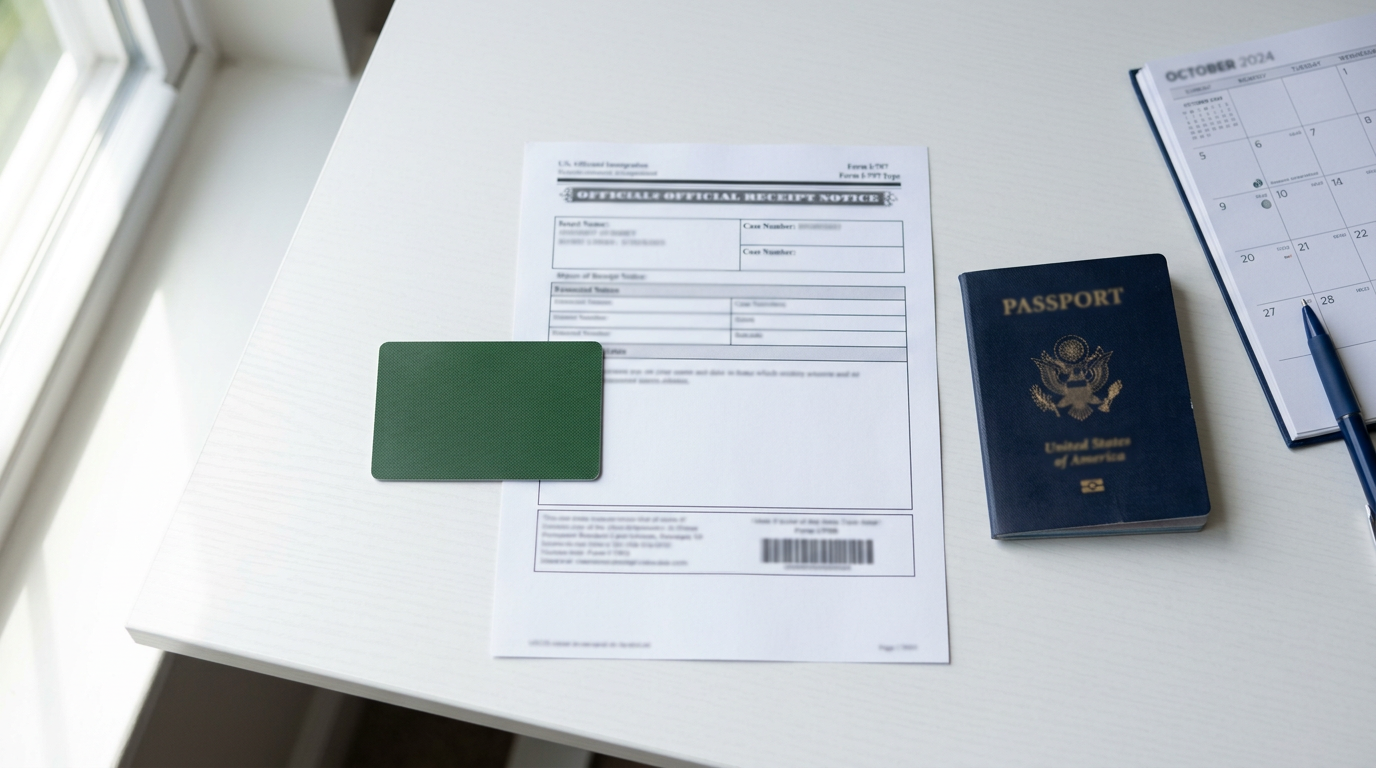
Green Card expired while N-400 is pending: do you need to file Form I-90?
Our content is researched by immigration educators with experience helping naturalization applicants prepare for their interviews.
Editorial Standards: All content is based on official USCIS materials and reviewed for accuracy. Learn more about our team
Your Green Card has an expiration date on the front, and your naturalization case is still sitting with USCIS. The date passes. Nothing arrives in the mail. It is a genuinely unsettling moment, and the fear behind it is almost always the same one: did I just lose my status?
You did not. The plastic card and your legal status are two related but separate things. The card is the evidence of your lawful permanent resident (LPR) status — its formal name is the Permanent Resident Card, or Form I-551. Lawful permanent residence itself does not carry an expiration date printed on a card. What expires is your proof, and proof can be extended or replaced.
Quick answer
In most cases, no. If you filed Form N-400 on or after December 12, 2022, your receipt notice extends your Green Card's validity for 24 months past the expiration date printed on the card, so paying for Form I-90 is usually unnecessary. The main exceptions are a lost, stolen, damaged, or destroyed card, a two-year conditional card, or an extension that has already run out.
Your situation, and what it normally calls for
| Situation | Is Form I-90 normally needed? | What may serve as proof | Recommended next step |
|---|---|---|---|
| 10-year card expires after you filed N-400 | Normally no | Expired card plus N-400 receipt notice (Form I-797) | Keep both documents together; note the 24-month end date |
| Card had already expired when you filed N-400 | Normally no, if the extension still covers you | Expired card plus N-400 receipt notice | Count 24 months from the card's expiration date; if that date has passed, request temporary evidence |
| Card lost or stolen | Yes — generally required | Neither document alone; you have no card to pair with the notice | File Form I-90 for a replacement; ask USCIS about temporary evidence |
| Card damaged or destroyed | Usually yes if it is unreadable or gone | A badly damaged card may not be accepted as evidence | File Form I-90; keep the damaged card until told otherwise |
| Your N-400 extension has expired | Not automatically | Neither document combination is current | Contact the USCIS Contact Center to request temporary evidence (ADIT stamp) |
| International travel planned | Not automatically | Expired card + receipt notice within the extension; passport | Read the travel section below; consider legal advice for long or complicated trips |
| Employer requests documentation | No | Expired card + N-400 receipt notice (List A for Form I-9) | Present both together; you choose which acceptable documents to show |
| You hold a 2-year conditional card | No — I-90 is the wrong form | Depends on your pending petition, not on I-90 | Use Form I-751 (or I-829 for investors) to remove conditions |
Does an expired Green Card mean you lost permanent resident status?
No. LPR status ends only in specific legal ways — for example, abandonment of residence, rescission, or an immigration judge's removal order after proceedings. A date printed on a piece of plastic is not one of them.
What an expired card does affect is everyday life: showing an employer that you are authorized to work, boarding a flight back to the United States, satisfying a state agency, proving who you are. That is a documentation problem, and USCIS has built a documentation solution into the naturalization process itself.
One caution that belongs here rather than buried at the end: an extension notice does not erase other problems. If you spent a long stretch outside the United States, have an arrest record, or have been placed in removal proceedings, filing N-400 does not neutralize any of that. Those issues are decided on their own terms.
What happens when your Green Card expires while N-400 is pending?
Since December 12, 2022, USCIS automatically extends the validity of a Permanent Resident Card for people who file Form N-400. The extension is 24 months, measured from the “Card Expires” date printed on the card, and the Form I-797 receipt notice you get after filing is the document that proves it. USCIS made this change specifically to reduce the number of I-90 filings and field-office stamp appointments that naturalization applicants used to need.
Three details decide whether this actually helps you:
It applies to N-400s filed on or after December 12, 2022. If you filed before that date, you are not covered by this automatic extension and would follow the older path — a replacement card or temporary evidence from a field office.
The two documents work as a pair. The receipt notice alone is not the extension. You must be able to present the expired physical card together with the receipt notice. This is why a lost card changes the whole answer.
It does not create a new card. Nothing is being renewed. USCIS is simply treating your existing card, plus the notice, as current evidence for a defined window. If your naturalization is approved, you become a citizen and will not need a new Green Card at all.
Worked example (fictional, for illustration only)
Ana's card shows “Card Expires 03/14/2026.” She files Form N-400 in June 2025 and receives her receipt notice. Her card's expiration date does not move, but the 24-month extension runs from that date, so her expired card paired with her receipt notice serves as evidence through March 14, 2028. If Ana had instead filed Form I-90, the 36-month extension would have run to March 14, 2029 — a full year longer. Same card, different form, different window. Check the actual dates and language printed on your own notice; do not rely on this example.
Do you need to file Form I-90 while waiting for citizenship?
When it is usually unnecessary. You filed N-400 on or after December 12, 2022, you still physically have your card, it is readable, and you are inside the 24-month window. Paying a filing fee here typically buys you nothing you do not already have.
When it is required or sensible anyway. Your card is lost, stolen, destroyed, or too damaged to serve as evidence. Or the card expired so long ago that a 24-month extension from its expiration date has already run out. Or your card contains an error that needs correcting. In these situations, the pairing that makes the extension work simply is not available to you. Federal law expects lawful permanent residents to have evidence of registration in their possession, so “I'll just wait for citizenship” is not a safe plan when the card itself is gone.
When to contact USCIS instead of filing. If your extension has expired while your case is still pending, or if you have an urgent, documented need for proof, the answer is temporary evidence — not a new I-90. Start with the USCIS Contact Center.
When to talk to an attorney rather than a form. If your status is disputed, your USCIS records conflict with your documents, you have prior removal proceedings, or you are worried about abandonment, the question is no longer which form to file.
Take the Full 2026 Civics Test Simulator →
Practice all 128 official USCIS questions. Unlock the complete simulator with bilingual support.
No account required for free quiz
Before you spend money on Form I-90
This section exists because the most common expensive mistake in this topic is paying for a replacement card you already had covered — and the second most common is skipping a filing you actually needed.
You may not need to pay if you filed N-400 on or after December 12, 2022, you hold the physical card, and you are inside the 24-month window. You may still need to pay if the card is missing, unreadable, wrong, or if the extension has lapsed. Either way, confirm the current rule and the current fee on the official USCIS pages before you pay anything. USCIS changes extension periods and fees; the 24-month N-400 rule and the 36-month I-90 rule were both changes, and both took effect on specific dates.
This article cannot decide your case. It can only tell you which questions determine the answer.
| Path | Government cost | What to verify before acting |
|---|---|---|
| Relying on the valid 24-month N-400 extension | No additional government fee | That your card is physically available and that you are inside the window printed on/derived from your notice |
| Filing Form I-90 when required | A government filing fee applies; the amount differs between online and paper filing | The current amount on the USCIS Fee Calculator before you submit payment |
| Requesting a fee reduction or waiver | May be available through Form I-912 in qualifying circumstances | Whether you qualify and how it must be submitted on the official Form I-912 page |
| Obtaining temporary evidence of status (ADIT stamp) | USCIS guidance describes a request process rather than a separate application fee | Confirm with the Contact Center what, if anything, is charged and what to bring |
| Consulting an immigration attorney | Varies entirely by location, case, and provider | Nothing reliable can be estimated here, and no average is quoted on purpose |
N-400 extension versus I-90 extension
These two extensions are frequently confused. They come from different filings, last different periods, and serve different purposes.
| N-400 automatic extension | I-90 automatic extension | |
|---|---|---|
| Purpose | Keeps your existing card usable as evidence while naturalization is pending | Keeps your existing card usable as evidence while a replacement/renewal card is produced |
| Who receives it | People who filed Form N-400 on or after December 12, 2022 | People who properly filed Form I-90 to renew an expiring or expired card |
| Current extension period | 24 months from the “Card Expires” date | 36 months from the “Card Expires” date |
| Documents used together | Expired card + Form I-797 N-400 receipt notice | Expired card + Form I-797 I-90 receipt notice |
| Produces a new card? | No | Yes — a replacement card is the point of the filing |
| When extension expires | Request temporary evidence of status (ADIT stamp) if case is still pending | Same; contact USCIS if the card has not arrived |
| Official source | USCIS alert (Dec. 2022 policy update) | USCIS alert (Sept. 2024 policy update) |
What if your Green Card was lost, stolen, damaged, or destroyed?
Lost is not the same as expired, and the difference is the whole point. The N-400 extension works by pairing your card with your notice. With no card, there is nothing to pair.
In that situation the ordinary path is Form I-90 for a replacement, plus temporary evidence of status if you need proof before the card arrives. A card that has been through a washing machine, cracked in half, or printed with the wrong information sits in the same category: if it cannot function as evidence, treat it as unavailable. Keep the damaged card rather than discarding it, and follow the instructions USCIS gives you.
What if the N-400 extension expires before USCIS makes a decision?
Processing sometimes outlasts 24 months. If that happens, your status has not lapsed, but your documentation has, and you can request temporary evidence.
Start by calling the USCIS Contact Center at 800-375-5283. Under current USCIS guidance on temporary status documentation, there are two possible outcomes. USCIS may issue temporary evidence by mail — a Form I-94 carrying the ADIT stamp (Alien Documentation, Identification and Telecommunication), a DHS seal, and a printed photo — after verifying your identity, your mailing address, and that you can receive courier delivery. Or USCIS may schedule an in-person appointment at a field office, which is more likely if identity or address verification does not work, if there is no usable photo in USCIS systems, or if you need documentation the same day.
For an appointment, plan on bringing your valid passport, your expired card if you still have it, your Form I-797 receipt notice, government-issued photo identification, and your appointment confirmation. If your need is urgent, bring documentation of it. USCIS decides these requests case by case, and no one can promise you the same outcome, timing, or validity period someone else received. Do not wait until the week before a flight or a job start date.
Can you work with an expired Green Card while N-400 is pending?
Yes, in the ordinary case. Under USCIS I-9 Central guidance, an expired Permanent Resident Card presented together with the Form N-400 receipt notice functions as a List A document combination for Form I-9, Employment Eligibility Verification, as long as it is presented before the extension period ends. An ADIT stamp is likewise treated as List A evidence.
Two points employees regularly need. First, employers complete Form I-9 based on documents the employee chooses from the acceptable lists; an employer generally may not demand one specific document when you have provided acceptable documentation. Second, when USCIS changed the I-90 extension from 24 to 36 months, it instructed employers not to reverify current employees who had already presented a combination reflecting the earlier 24-month notice. If your employer is unsure, the I-9 Central pages are written for them, not just for you.
Can you travel with an expired Green Card and N-400 receipt?
This is the section where honesty matters more than reassurance. Travelers commonly carry a passport, the expired card, and the receipt notice showing the extension. Within the extension window, that combination is intended to serve as evidence of LPR status. Airlines check documents before boarding, and their staff are not always familiar with extension notices; carrying a printed copy of the relevant USCIS page can help. On return, admission is determined by U.S. Customs and Border Protection at the port of entry.
No article can guarantee that you will be boarded or admitted. Those decisions are not made by USCIS and not made in advance.
There is a second layer while N-400 is pending: time abroad can affect continuous residence and physical presence. A trip that solves a documentation problem can create an eligibility problem. If you are planning a long absence, or you already have significant time outside the country, get advice first and check your own numbers with the Physical Presence Calculator. Our guide on traveling after filing Form N-400 covers this in more detail.
Practice the Real Interview Format
Our simulation mode stops after 6 correct answers (PASS) or 5 wrong answers (FAIL) — exactly like USCIS.
What should you bring to your naturalization interview?
Generally applicable: your interview appointment notice; your Permanent Resident Card, even if expired; your Form N-400 receipt notice showing the extension; a valid passport and any expired passports covering your time as a resident; state-issued photo identification.
Case-specific: marriage, divorce, or death certificates; court dispositions for any arrest or citation; tax records; evidence relating to time abroad; documents for name changes; anything USCIS specifically requested in your notice. Build your own list with the N-400 Document Checklist Generator, and see our interview document guide.
Special rules for two-year conditional Green Cards
If your card is valid for two years, you are a conditional permanent resident, and the rules here are different. The official Form I-90 page states directly that you should not submit that form if you are a conditional resident seeking to remove the conditions on your Green Card. Conditions are removed through Form I-751 for conditional residence based on marriage, or Form I-829 for conditional residence based on investment.
Filing I-90 in this situation does not remove conditions and does not fix the underlying problem. Confirm which petition applies to you before filing anything, and read our guide to conditional Green Cards and citizenship.
Mistakes to avoid
- Paying for Form I-90 without first checking whether your N-400 receipt notice already covers you.
- Assuming an expired card means your status ended.
- Mixing up the two extension periods — 24 months for N-400, 36 months for I-90.
- Carrying only the receipt notice when the expired card must be presented with it.
- Ignoring a lost, stolen, or damaged card because citizenship “should” arrive soon.
- Assuming international travel is automatically safe because you hold an extension notice.
- Using Form I-90 to try to remove conditions on a two-year card.
- Waiting until days before a flight or a start date to request temporary evidence.
Step-by-step action plan
- Identify whether your card is a 10-year card or a 2-year conditional card.
- Locate your Form N-400 receipt notice (Form I-797) and note the filing date.
- Check the “Card Expires” date printed on your card.
- Calculate the extension from that date using the period stated in current USCIS guidance and on your notice.
- Confirm you physically have the card and that it is readable.
- Consider upcoming travel or employment needs, and how much runway you have.
- Decide whether you need Form I-90, temporary evidence, or nothing at all.
- Contact the USCIS Contact Center, or an immigration attorney, when your situation falls outside the ordinary case.
You can also confirm where you stand overall with the Citizenship Eligibility Calculator and map your dates with the Citizenship Timeline Calculator.
When to speak with an immigration attorney
- Any arrest, citation, or criminal history
- Past or current removal proceedings
- Any possibility that USCIS could view a long absence as abandonment of residence
- Extended trips outside the United States
- Any prior finding or allegation of fraud or misrepresentation
- Status that is unclear, terminated, or disputed
- Problems with conditional residence, including a missed I-751 deadline
- Missing core documentation
- Conflicts between your documents and USCIS records
None of these are reasons to panic. They are reasons to get an individual assessment instead of a general article — including this one.
Frequently asked questions
Can USCIS deny my N-400 because my Green Card expired?
Card expiration is not a ground for denying naturalization. Eligibility turns on residence, presence, good moral character, and the other statutory requirements. Bring the expired card and your receipt notice to your interview.
Can I apply for naturalization with an already-expired Green Card?
Yes. Being a lawful permanent resident is what matters, not whether the card is current. USCIS guidance applies the automatic extension to eligible naturalization applicants measured from the card’s expiration date.
Does the N-400 receipt notice renew my Green Card?
No. It extends the period during which your existing card, presented with the notice, serves as evidence of your status. No new card is produced.
Do I have to carry the receipt notice together with the expired card?
For the extension to work as evidence, yes — the two documents function as a pair. Keep copies, and keep the originals available when you need to present them.
What if I lose my Green Card after filing N-400?
The extension depends on having the physical card, so losing it generally means filing Form I-90 for a replacement and asking USCIS about temporary evidence in the meantime.
Can I travel internationally while my N-400 is pending?
Many people do, carrying a passport, the expired card, and the receipt notice. Boarding is an airline decision and admission is a CBP decision, so nothing is guaranteed. Long absences can also affect continuous residence.
What if the extension expires before my interview?
Your status continues. Contact the USCIS Contact Center to request temporary evidence — either an ADIT stamp mailed on a Form I-94 or an appointment at a field office.
Do conditional residents get the same 24-month extension?
Conditional residence is governed by its own process. Conditions are removed through Form I-751 or Form I-829, not Form I-90, and conditional residents should confirm their specific situation rather than assuming the naturalization extension applies to them.
Can my employer accept an expired card with an extension notice?
Under USCIS I-9 Central guidance, the expired card presented with the N-400 receipt notice is treated as a List A combination while the extension is valid. Employers complete Form I-9 from the documents the employee chooses.
Should I file Form I-90 and Form N-400 at the same time?
Usually there is no need, because the N-400 receipt notice already extends your card’s validity. It becomes a real question when the card is missing, unreadable, or the extension window has already closed.
The bottom line
An expired Green Card while your N-400 is pending is a paperwork issue, not a status issue. If you filed on or after December 12, 2022 and you still have your card, your receipt notice extends that card's validity for 24 months and you probably do not need to pay for Form I-90. If the card is gone or unreadable, or if 24 months have already passed, the answer changes — to a replacement application or to temporary evidence from USCIS.
Your next step is small: find your receipt notice, look at the expiration date on your card, and do the arithmetic. Then check where you stand on eligibility, organize your documents, and when you are ready, practice for the interview.
Keep studying on your phone
Practice the USCIS citizenship test with quizzes, flashcards, and interview simulation — in English and Spanish, right from your iPhone or Android device.
- 128 civics questions
- Interview simulation
- English & Spanish


US Civics Practice provides educational information about the naturalization process. We are not a law firm, we do not provide legal advice, and we are not affiliated with USCIS or any government agency.
Sources reviewed
- USCIS, I-90, Application to Replace Permanent Resident Card (page last reviewed 06/16/2026)
- USCIS newsroom alert, USCIS Updates Policy to Automatically Extend Green Cards for Naturalization Applicants
- USCIS newsroom alert, USCIS Extends Green Card Validity Extension to 36 Months for Green Card Renewals
- USCIS I-9 Central, USCIS Extends Validity of Expired Permanent Resident Cards from 24 Months to 36 Months for Renewals
- USCIS I-9 Central, Temporary Status Documentation for Lawful Permanent Residents (LPR)
- USCIS newsroom alert, USCIS Announces Additional Mail Delivery Process for Receiving ADIT Stamp
- USCIS, Replace Your Green Card; USCIS Fee Calculator