
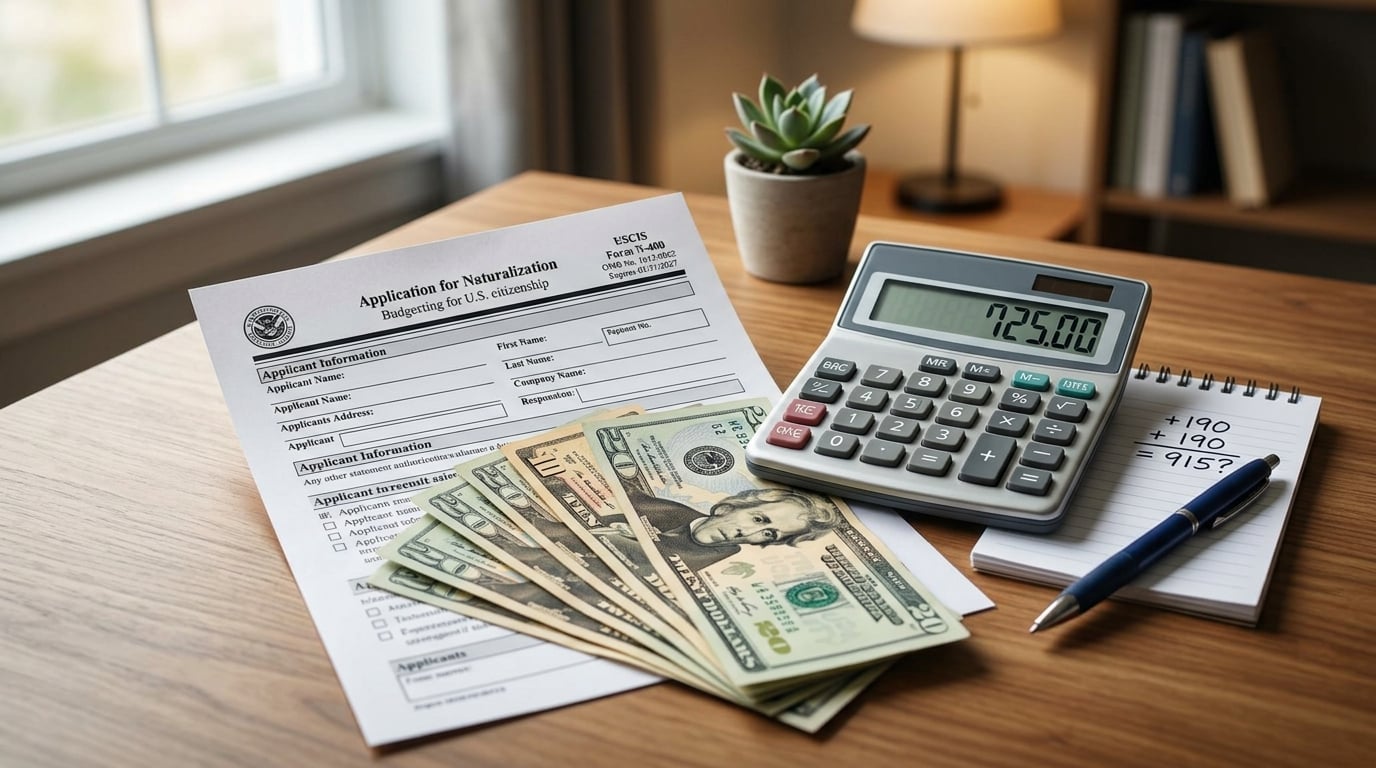
Illustrative photo. Not an official USCIS document.
USCIS citizenship fee increase 2026: what's confirmed so far
Our content is researched by immigration educators with experience helping naturalization applicants prepare for their interviews.
Editorial Standards: All content is based on official USCIS materials and reviewed for accuracy. Learn more about our team
On June 22, 2026, DHS proposed a large N-400 fee increase for 2026: the citizenship application fee would jump to $1,330 for paper filings (up from $760) and $1,280 online (up from $710) — roughly a 75 to 80 percent increase. But here is the part that matters most today: this is only a proposed rule, not a final one.
Nothing has changed yet. The current fees — $760 paper and $710 online — are still in effect right now, and no one is being charged the higher amount. If you saw a scary headline and worried you had missed your chance, take a breath. You have not.
This guide lays out exactly what is confirmed, what is still just a proposal, what it would mean if it becomes final, and the practical steps you can take right now — including how to submit an official comment on the rule.
The short version
DHS proposed raising the N-400 citizenship fee to $1,330 (paper) / $1,280 (online) in a rule published June 22, 2026. It is not law yet. Current fees of $760 / $710 still apply.
There is a 60-day public comment period open until about August 21, 2026, and DHS must review those comments before any final rule. There is no confirmed effective date for the higher fees.
How much would the N-400 fee be in 2026?
Here are the numbers side by side, so you can see exactly what is being proposed and what you would actually pay today.
| Form & filing type | Current fee (in effect now) | Proposed fee |
|---|---|---|
| N-400, paper | $760 | $1,330 |
| N-400, online | $710 | $1,280 |
| N-336 appeal, paper | $830 | $1,475 |
| N-336 appeal, online | $780 | $1,425 |
DHS describes this as a “full-cost, beneficiary-pays” model — the idea that applicants should cover the full cost of processing, including expanded background checks and vetting. Whether that framing survives the comment process is exactly what the next couple of months will decide.
What's confirmed vs. what's still proposed
This is the distinction that keeps people from panicking or making a rushed decision. Here is where each piece actually stands.
Confirmed
- DHS published a proposed rule in the Federal Register on June 22, 2026.
- A 60-day public comment period is open, running through about August 21, 2026.
- Current fees — $760 paper / $710 online for the N-400 — remain in effect right now.
- DHS frames the change as a full-cost, beneficiary-pays model to cover expanded background checks and vetting.
Still proposed (not law)
- The higher fees ($1,330 / $1,280 for the N-400) would apply only if finalized.
- The proposal would eliminate income-based fee waivers and reduced fees.
- The N-336 appeal fee increase is proposed, not charged.
- There is no confirmed effective date for any final rule.
Would the N-400 fee waiver be eliminated?
Under the proposal, yes. This is the change that would hit lower-income applicants hardest. The proposed rule would eliminate income-based fee waivers and the reduced fee that is currently available to applicants earning below 400 percent of the federal poverty guidelines.
Under the proposal, only active-duty military members and certain veterans would remain exempt from the full fees.
Important: fee waivers and reduced fees are still available today under the current rules. This part of the change only takes effect if the rule is finalized.
What about the N-336 appeal fee?
The N-336 is the form you file to request a hearing if your naturalization application is denied. The proposed rule would raise its fee to $1,475 for a paper filing (up from $830) and $1,425 online (up from $780).
For most applicants this fee never comes up, because most cases are not denied. But if you are worried about a denial, the best protection is a strong, well-prepared application in the first place — being ready for the civics test and interview is a big part of that.
When could the new fees take effect?
There is no confirmed effective date. Here is the process a proposed rule has to go through before anything changes:
- The 60-day public comment period runs from June 22, 2026 to about August 21, 2026.
- DHS then reviews and responds to the comments — this typically takes additional weeks to months.
- Only after that can DHS publish a final rule, which would include its own effective date.
In plain terms: the higher fees are not going to appear overnight, and current fees apply for now. But there is also no guarantee about timing, which is why anyone who is already eligible and ready may not want to wait indefinitely.
What should you do right now?
You do not need to panic, and you do not need to rush a bad application. Here is a calm, practical order of operations.
- Confirm you are actually eligible. Filing early to beat a fee only helps if your application is solid. Use our citizenship eligibility calculator to check your earliest filing date.
- Get your documents in order. A complete filing avoids delays and rejections. Our N-400 document checklist generator builds a personalized list for your situation.
- Understand the full cost. Our guide on how much it costs to apply for citizenship in 2026 breaks down current fees and what to budget.
- If you feel strongly about the fee change, comment on it. The comment period is your official chance to be heard — see the steps below.
- Start preparing for the test. Once you file, the interview and civics test come next. Getting ready now means a fee change never catches you off guard.
Preparing to file? Get ready for the test too.
The Full Pass Bundle gives you unlimited practice with all 128 official questions, real interview simulations, and a bilingual study guide — so once your application is in, you walk into the interview confident.
Prepare with the Full Pass — $14.99Start with 10 free practice questions first — no sign-up required.
How to submit a public comment on the proposed rule
A public comment period is not a formality — DHS is legally required to consider the comments it receives. Anyone can submit one, and you do not need a lawyer to do it. The comment period is open until approximately August 21, 2026.
- Go to the federal rulemaking portal at regulations.gov .
- Search for the proposed rule by its title (the naturalization and immigration fee rule) or its docket number, which is listed in the Federal Register notice.
- Open the rule and select “Comment.”
- Write your comment in your own words. Explain who you are, how the change would affect you or your family, and what you would like DHS to do. Specific, personal, respectful comments carry more weight than form letters.
- Submit before the deadline. Comments are part of the public record, so avoid including sensitive personal details you do not want public.
Whether or not you comment, the fees that apply to your case are the ones in effect on the day you file — which today are still $760 (paper) and $710 (online).
Frequently asked questions
How much will the N-400 citizenship application cost in 2026?
Right now, the N-400 fee is still $760 for a paper application and $710 for an online application. In a proposed rule published on June 22, 2026, DHS asked to raise the N-400 fee to $1,330 (paper) and $1,280 (online) — roughly a 75 to 80 percent increase. That higher amount is only a proposal. It is not in effect, and no one is being charged the higher fee yet.
Is the USCIS fee increase final or just proposed?
It is just proposed. What DHS published on June 22, 2026 is a Notice of Proposed Rulemaking, not a final rule. The current fees ($760 paper / $710 online for the N-400) remain in effect. There is a 60-day public comment period running through approximately August 21, 2026, and DHS must review those comments before it can issue any final rule. There is no confirmed effective date for the new fees.
Will the N-400 fee waiver be eliminated?
Under the proposal, yes. The proposed rule would eliminate income-based fee waivers and the reduced fee for applicants earning below 400 percent of the federal poverty guidelines. Only active-duty military members and certain veterans would remain exempt from the full fees. Because this is only a proposal, fee waivers and reduced fees are still available under the current rules today.
How much is the N-336 appeal fee increase?
The N-336 is the request for a hearing after a naturalization denial. The proposed rule would raise its fee to $1,475 for a paper filing (up from $830) and $1,425 online (up from $780). Like the N-400 change, this is proposed only and is not currently charged.
Should I file my N-400 now before the fee increase?
If you are already eligible and ready, filing under the current fees avoids the risk of a higher cost later, since there is no guaranteed effective date for the new fees. But you should only file when you genuinely meet the eligibility requirements and have your documents in order — filing an incomplete or premature application to beat a deadline can cause delays or a denial. Check your eligibility and timeline first, then decide.
Last updated: July 8, 2026. This covers a proposed rule, not a final one. The comment period closes around August 21, 2026, and the details above may change once DHS reviews comments and decides whether to issue a final rule. We will update this page as the status changes. For the official notice, check the Federal Register and uscis.gov.
Content last reviewed: July 8, 2026. This article is for educational purposes only and does not constitute legal advice. US Civics Practice is not affiliated with, endorsed by, or connected to USCIS or any government agency. Immigration policies and fees can change; details may be out of date by the time you read this. For your specific case, consult a licensed immigration attorney, and for official information, visit uscis.gov .