
What Happens If You Forget Documents at Your U.S. Citizenship Interview? (2026 Guide)
Our content is researched by immigration educators with experience helping naturalization applicants prepare for their interviews.
Editorial Standards: All content is based on official USCIS materials and reviewed for accuracy. Learn more about our team
Free Tools That Can Help
Forgetting documents at your citizenship interview does NOT automatically mean your application will be denied. If you left something at home or realized too late that you were missing paperwork, take a breath. This situation is more common than you might think, and USCIS has established procedures to handle it.
When applicants arrive with missing documents at their N-400 interview, USCIS typically handles the situation through one of several standard processes. The most common outcomes include case continuation, a Request for Evidence (RFE), or a follow-up submission opportunity. Officers understand that applicants are often nervous and may overlook items on their checklist. Before your interview, make sure to review our complete citizenship interview document checklist to minimize this risk.
This guide explains exactly what happens when you have citizenship interview missing paperwork, what steps you can take to fix the situation, and how to avoid document problems in the future. Whether you forgot your naturalization interview documents in 2026 or simply want to prepare, this guide has you covered.
Quick Answer: What You Need to Know
- •Will USCIS deny you? Not automatically. Missing documents alone rarely result in immediate denial.
- •What usually happens? Your case is continued, or you receive an RFE asking for the missing items.
- •Can you fix it? Yes. You will typically have 30–87 days to submit the missing documents.
- •Should you panic? No. This is a common situation with established solutions.
- •What should you do next? Wait for official instructions, then respond promptly and completely.
How Serious Is It to Forget Documents at a Citizenship Interview?
The short answer: it is usually not as serious as you fear. While forgetting documents can cause delays, it rarely leads to denial on its own. USCIS has clear procedures for handling missing paperwork, and officers are trained to work with applicants who are otherwise eligible.
From an officer's perspective, missing documents are common. Officers are trained to document the issue and provide clear next steps rather than deny applications immediately. Their goal is to verify your eligibility, not to catch you on technicalities. If you are honest about what you forgot and follow instructions for submitting the missing items, your case will typically proceed normally.
That said, how serious the situation becomes depends on what document is missing and how you respond. A forgotten passport copy is very different from being unable to provide proof of continuous residence. The key is to stay calm, follow the process, and respond promptly to any requests.
Why USCIS Requires Documents at the Interview
Understanding why USCIS asks for specific documents can help you prioritize what to bring. The citizenship interview serves several important purposes, and documents play a key role in each one.
- Identity Verification
Your green card, passport, and photo ID confirm you are who you claim to be. These documents help the officer verify your identity before proceeding with the interview.
- Eligibility Confirmation
Documents like marriage certificates, tax records, and Selective Service proof help confirm you meet the requirements for naturalization. They support the answers you provided on Form N-400.
- Supporting Evidence Review
The officer reviews your documents to verify the information in your application. This includes checking travel history, employment records, and any other relevant details.
For a complete list of what to bring, see our guide on documents to bring to your citizenship interview.
USCIS Case Continuation: What It Means
A case continuation is one of the most common outcomes when you forget documents at your citizenship interview. It means your case is placed on hold while you gather and submit the missing items.
During a case continuation, the officer does not make a final decision on your application. Instead, they note which documents are missing and give you time to provide them. You will receive written instructions explaining exactly what is needed and how to submit it.
How common is case continuation?
Case continuation is a routine procedure. USCIS officers use it regularly when applicants are missing documentation but otherwise appear eligible for citizenship. It is not a negative mark on your application.
After you submit the missing documents, USCIS will review them and continue processing your case. In most situations, you will not need to attend another in-person interview.
Request for Evidence (RFE) After Your Interview
A Request for Evidence, sometimes called Form N-14, is a formal notice from USCIS asking you to provide specific documents. If you forgot something at your interview, you may receive an RFE in the mail or through your USCIS online account.
The RFE will clearly list the documents USCIS needs and provide a deadline for submission. Typical response windows range from 30 to 87 days, depending on the complexity of the request.
Important: Respond on time and completely
When you receive an RFE, follow the instructions exactly. Submit all requested documents before the deadline. Incomplete or late responses can delay your case or lead to denial.
For detailed guidance on handling an RFE, see our article on what happens if USCIS requests more evidence (Form N-14).
Will USCIS Deny My Citizenship for Missing Documents?
USCIS does not automatically deny citizenship applications because of missing documents at the interview. However, denial can occur in certain situations.
Denial is most likely if you fail to respond to an RFE, miss the submission deadline, or if the missing documents reveal an eligibility problem. For example, if USCIS requests tax transcripts and you cannot provide them because you did not file taxes, this could affect your application.
Realistic denial scenarios:
- You do not respond to the RFE at all
- You miss the submission deadline
- The missing document reveals an eligibility issue you cannot resolve
- You submit incomplete or incorrect documents after multiple requests
In practice, most applicants who forget documents are able to resolve the situation by submitting the missing items on time. USCIS officers are generally understanding and follow established procedures to give applicants a fair opportunity to complete their cases.
Real Example: What Happens If You Forget Tax Transcripts?
Here is a realistic example of how USCIS handles missing documents at a citizenship interview.
Situation: Maria arrives at her N-400 interview and realizes she forgot to bring her IRS tax transcripts for the past five years. The officer notices this during the document review.
What happens: The officer continues the interview, asking Maria the civics and English test questions. At the end, the officer explains that Maria's case will be continued pending receipt of the tax transcripts. Maria receives a written notice listing exactly what she needs to submit.
Next steps: Maria requests her tax transcripts from the IRS online and receives them within two weeks. She mails them to the address provided in her notice, along with a copy of the notice itself.
Outcome: Eight weeks later, Maria receives her oath ceremony notice. Her case proceeded normally after she submitted the missing documents.
This example shows that forgetting a document is not the end of the road. By responding promptly and following instructions, most applicants successfully complete their cases.
Most Common Documents Applicants Forget
Knowing which documents are most commonly forgotten can help you double-check your folder before leaving home. Here are the items applicants most often leave behind:
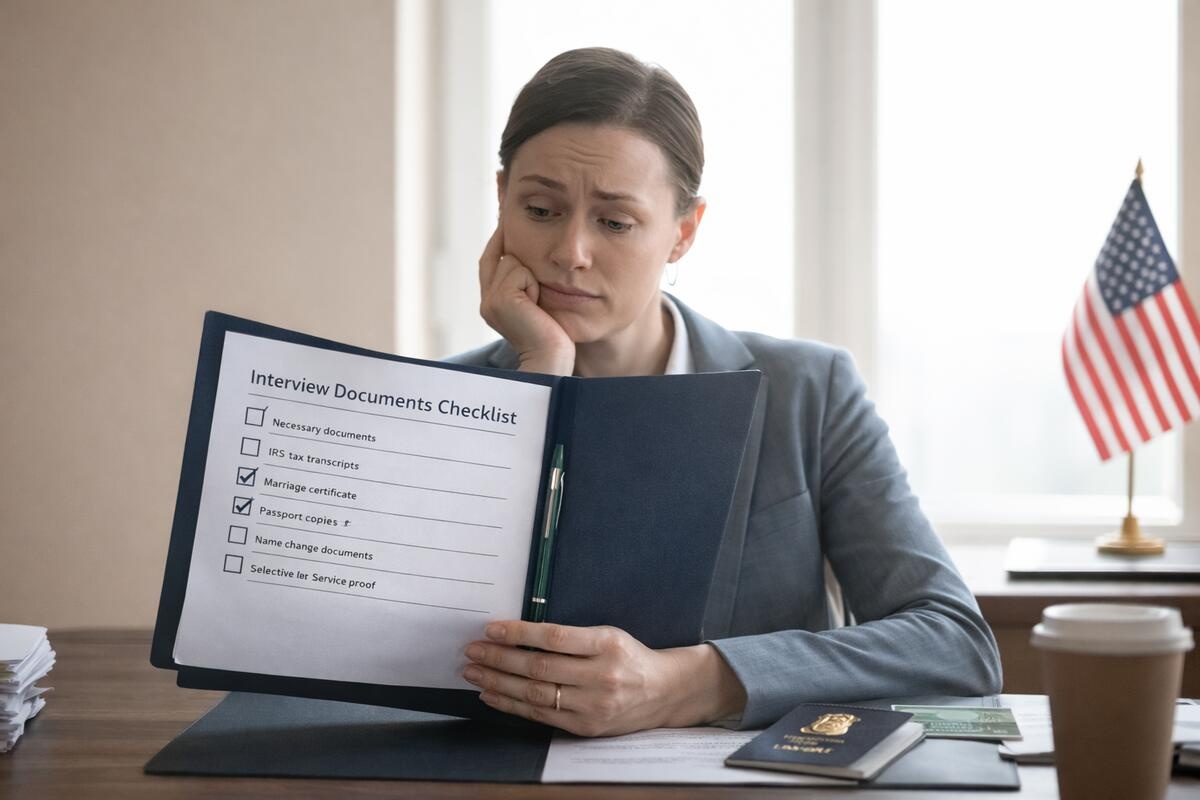
- •Tax transcripts — IRS transcripts for the past 3–5 years
- •Marriage certificate — Required if applying through marriage to a U.S. citizen
- •Travel records — Passport pages showing entry and exit stamps
- •Selective Service proof — Registration confirmation for male applicants
- •Name change documents — Court orders or marriage certificates showing legal name changes
- •Passport copies — Current and expired passports
- •Divorce decrees — If previously married
What To Do If You Realize Before the Interview
If you realize you are missing a document before your interview, you still have options. Here is what to do:
- Do not skip your interview. Attend as scheduled, even if you are missing something.
- Bring everything else. The more complete your documentation, the better.
- Tell the officer. At the start of your interview, let the officer know which document you are missing.
- Ask about submission options. The officer may allow you to mail or upload the missing item.
- Take notes. Write down any instructions the officer provides so you can follow them accurately.
Missing your interview entirely is worse than attending without all your documents. USCIS can reschedule interviews, but missed appointments can significantly delay your case.
What To Do If You Realize After the Interview
If you left a document at home and only realized after your interview ended, here is how to handle the situation:
- Wait for written notice
USCIS will send you a letter or notification through your online account explaining what is needed. Do not submit documents until you receive official instructions.
- Monitor your USCIS account
Check your account regularly for updates. Notices may appear online before arriving by mail.
- Respond carefully and completely
When you receive instructions, gather all requested items. Submit everything together to avoid further delays.
- Follow RFE instructions exactly
If you receive Form N-14 or another RFE, follow the instructions precisely. Use the correct address, include required cover sheets, and meet the deadline.
For guidance on uploading documents to your USCIS account, see our article on how to upload documents when filing Form N-400 online.
Pro Tips to Avoid Document Problems
Prevention is the best approach. Use this checklist to prepare for your interview and avoid forgetting important documents:
- ✓Review your interview notice for the specific documents requested
- ✓Use a printed checklist and check off each item as you pack
- ✓Organize documents in a folder with labeled dividers
- ✓Prepare documents at least one week before your interview
- ✓Make copies of everything—keep originals safe
- ✓Double-check your folder the night before and morning of the interview
- ✓Bring extra documents that might be relevant, even if not specifically requested
Frequently Asked Questions
Can USCIS deny citizenship for missing documents?
USCIS can deny a citizenship application if required documents are never provided after multiple opportunities. However, forgetting documents at the interview alone does not result in automatic denial. USCIS typically issues a case continuation or Request for Evidence (RFE) first, giving you time to submit the missing paperwork. Denial usually only happens if you fail to respond to these requests or if the missing documents reveal an eligibility issue.
Will I have to attend a second interview?
In most cases, no. If you forgot a document, USCIS will usually allow you to submit it by mail or through your online account. A second interview is typically only required if the officer needs to ask additional questions based on the missing documentation, or if there are concerns that require in-person clarification. Most applicants who forget documents do not need to return for another interview.
How long after an RFE will USCIS decide?
After you respond to a Request for Evidence (RFE), USCIS typically takes 60 to 120 days to make a decision, though this can vary by field office and case complexity. Some applicants receive decisions within a few weeks, while others may wait several months. You can check your case status through your USCIS online account for updates.
What if I forgot my green card?
If you forgot your green card at the interview, the officer will likely continue your case and ask you to submit a copy later. Your green card is a critical document for identity verification, so you will need to provide it. In some cases, the officer may be able to verify your status through USCIS systems, but you should still submit a copy as soon as possible. Do not panic—this is a common situation and can be resolved.
Can I upload documents later through my USCIS account?
Yes, in many cases you can upload documents through your USCIS online account after your interview. If you receive an RFE or case continuation notice, it will include instructions on how to submit the missing documents. Some field offices accept online uploads, while others require mailed copies. Always follow the specific instructions provided in your notice to ensure your documents are received and processed correctly.
Final Thoughts: Preparation Is Key
Forgetting documents at your citizenship interview is stressful, but it is not a disaster. USCIS has established procedures to handle missing paperwork, and most applicants who respond promptly to case continuations or RFEs successfully complete their naturalization.
The best approach is prevention. Use a detailed checklist, organize your documents well in advance, and double-check everything before you leave home. If you do forget something, stay calm, follow instructions, and submit the missing items as quickly as possible.
Use a printed checklist and practice your civics questions so you walk into your interview calm and fully prepared. When you feel confident about both your documents and your knowledge of U.S. history and government, interview day becomes much less stressful.
While you are waiting for your interview or preparing your documents, make sure you are also ready for the civics and English tests. Practicing all 128 USCIS civics questions can help you feel confident and prepared on interview day.
Disclaimer:
This article is for educational purposes only and does not constitute legal advice. USCivicsPractice.com is not affiliated with USCIS or any government agency. For specific questions about your case, consult official USCIS resources or a qualified immigration professional. For official information, visit uscis.gov.